Impelsys Architected the Foundation for AI-Enabled Connected Care

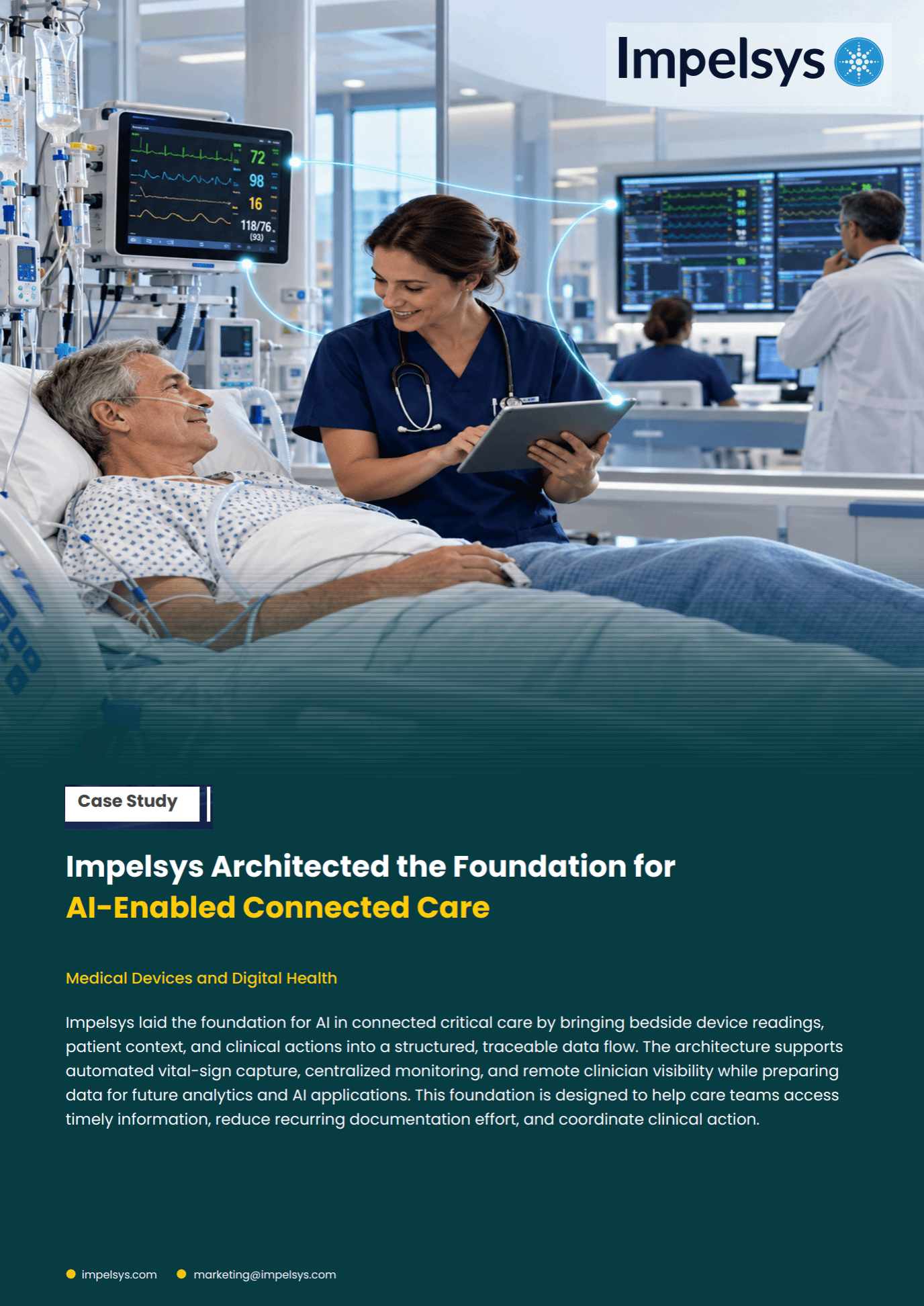
A leading medical technology company sought to move beyond standalone medical devices toward connected critical care. Nurses relied on manual vital-sign recording, while remote clinicians often depended on patient updates shared by bedside teams. The client needed a reliable way to connect device readings with patient information, reduce documentation effort, improve clinical visibility, and establish an accountable process for managing alerts.
Impelsys designed an integrated connected care architecture linking bedside devices, patient context, clinical workflows, and downstream analytics. The solution uses HL7 ORU and ADT messaging, buffered gateways, validated patient and bed associations, and configurable rules to bring device readings into clinical context. Centralized nursing dashboards and remote clinician access support coordinated care, while alert acknowledgement, snoozing, and escalation workflows provide traceability. A separate analytical data path establishes the foundation for future AI applications in critical care.
The connected care architecture establishes a structured, traceable foundation for future AI applications in critical care. Designed to support centralized monitoring across 50 ICU beds, the solution targets two-second data transfer latency and an 80% reduction in manual vital-sign documentation. A 30-second alert workflow target supports timely acknowledgement and escalation, while remote clinician access is designed to improve visibility into patient information. Together, these capabilities aim to reduce documentation effort, support coordinated clinical action, and prepare reliable data for downstream analytics and future AI evaluation.








2026 All Rights Reserved.
