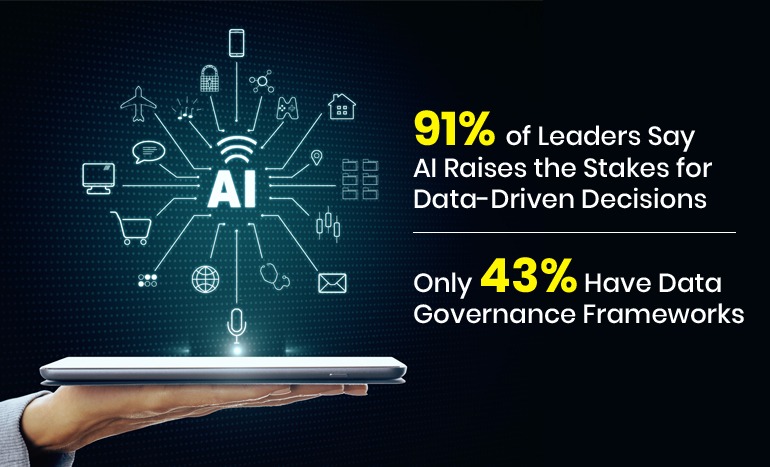
The McKinsey Global Survey shows a striking paradox: nearly nine out of ten organizations now report regular AI use in at least one business function, yet only about one-third have succeeded in scaling AI across the enterprise. This “88% vs. one-third” gap reveals a simple truth: adoption is happening fast, but durable, measurable value at scale is still rare.
The common blockers to scaling AI
Across enterprises, a consistent set of challenges continues to limit AI scale, a pattern echoed in industry research:
- Fragmented ownership. Projects live in function silos (marketing, product, IT) without a central operating model for AI.
- Weak data plumbing. Incomplete data pipelines and environment parity prevent models and agents from moving from lab to production.
- Operational fragility. Solutions that work in one team fail under broader load, or break as business processes evolve.
- Unclear value metrics. Teams optimize for model metrics (accuracy) rather than business metrics (cycle time, revenue uplift, cost per transaction).
These are the reasons many projects stall between the “88%” and the “33%.”
AI Agents: The new frontier and a lever for scaling
One of the most consequential trends McKinsey highlights is the growing use of AI agents, autonomous or semi-autonomous systems that can orchestrate tasks, call APIs, and act on behalf of teams. Agents are showing up for routine knowledge work, workflows, and even decision support use cases. When designed and governed correctly, agents shift automation from individual tasks to cross-functional processes, creating a powerful route to scale.
But AI agents introduce new challenges (governance, reliability, hallucination risk, and integration complexity), so they must be deployed within a strong engineering and operating model.
How Impelsys helps close the gap
At Impelsys we see the McKinsey gap as an opportunity for clients who combine three capabilities:
- Platform-grade engineering: Building production-ready AI systems (end-to-end pipelines, versioned models, and monitoring) so pilots become robust services.
- Process re-wiring: Designing workflows and APIs that let AI agents orchestrate across content systems, LMS platforms, and customer portals without fragile point-to-point integrations.
- Value-first governance: Defining business KPIs (time-to-publish, content personalization lift, learner completion rates) and aligning engineering, product, and business ownership to them.
Impelsys can help publishers, edtech platforms, and content businesses move from pilots to scale by:
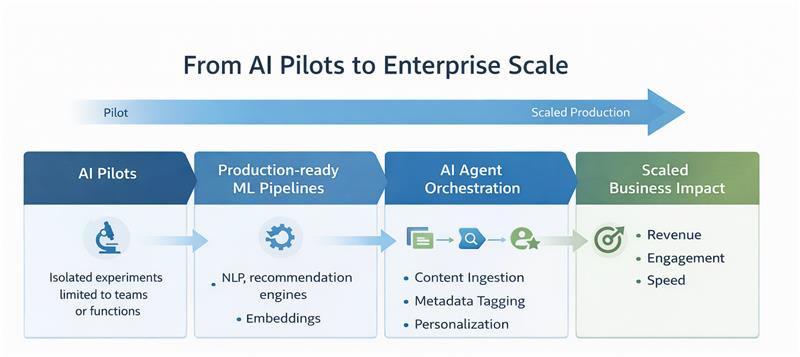
- Building resilient production pipelines for content-centric ML models (NLP, recommendation engines, embeddings).
- Implementing agent orchestration for common workflows (content ingestion → metadata tagging → personalized distribution).
- Creating measurement frameworks that tie AI outputs to revenue or learner success metrics.
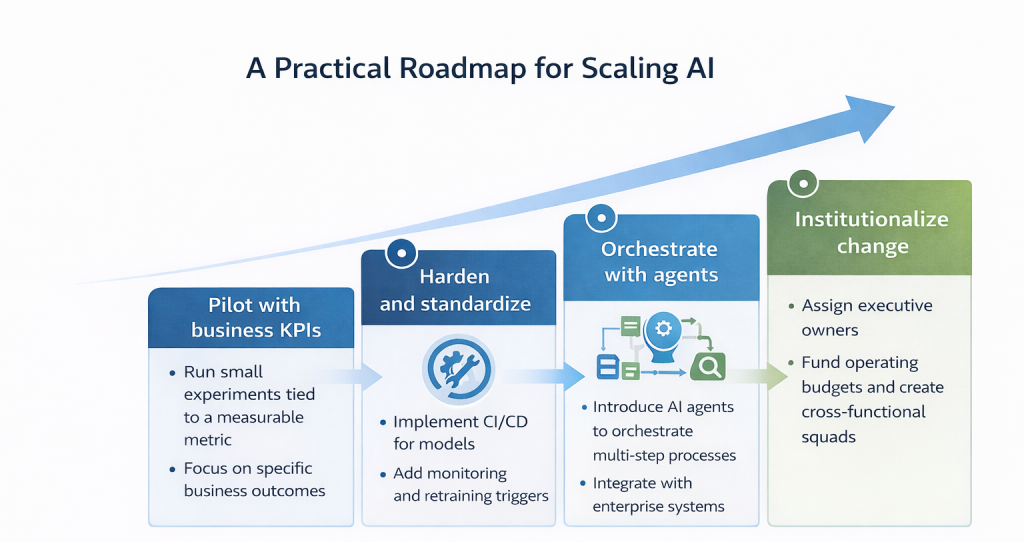
A practical roadmap for scaling AI (4 stages)
- Pilot with business KPIs. Run small experiments tied to a measurable metric (e.g., reduce time to publish by X%).
- Harden and standardize. Implement CI/CD for models, add monitoring and retraining triggers.
- Orchestrate with agents. Introduce AI agents to orchestrate multi-step processes and integrate with enterprise systems.
- Institutionalize change. Assign executive owners, fund operating budgets, and create cross-functional squads.
The McKinsey numbers are a wake-up call. While AI adoption is widespread, real enterprise value comes from disciplined execution, not experimentation alone. In practice, organizations that move beyond pilots tend to demonstrate a few consistent characteristics:
- Clear, measurable business impact, such as reduced costs, improved retention, and faster time-to-market
- AI capabilities that scale and repeat across business units, rather than remaining isolated within individual teams
- Strong operational foundations, including service-level metrics, performance monitoring, model drift detection, and defined retraining cycles
For enterprises navigating this shift, moving beyond point solutions to platform-level thinking is critical. AI agents and intelligent workflows must be embedded across systems to deliver consistent, scalable value. This is where Impelsys supports enterprises, helping them design, operationalize, and scale AI in ways that deliver sustained business impact.
Source: McKinsey Report
Authored by – Ravikiran SM and Rahi Sarkar