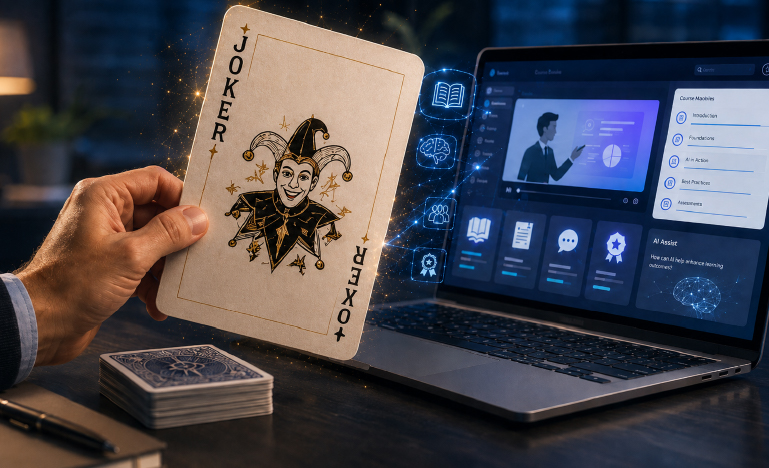
One way to increase learners’ engagement in training is to implement gamification. When done right, it motivates and engages learners and makes the learning process more immersive and practical. Gamification allows the learners to practice their skills in safe-realistic situations in a virtual setting which enables the learner to understand difficult concepts with ease and fun.
What Is Gamification?
Gamification is a technique that captures the elements of games into learning situations or training scenarios to provide a positive learning outcome for the learner. By weaving game mechanics such as leaderboards, points and badges, and other fun features of the games into the training modules, these gamified experiences feed into the innate sense of competition thereby motivating and encouraging the learner.
The purpose of gamification is to increase the effectiveness of training by providing a more engaging and fun learning experience. Gamification applies game elements to promote engagement and participation. These elements often include:
- Challenges/tasks/puzzles performed by the users to proceed to the next level while progressing towards a set of objectives.
- Points collected by the users as a result of completing a task/stage.
- Badges earned by users serve as rewards for successfully finishing a task.
- Levels that users pass on completing a certain stage.
- Avatars for a user profile in an online module to engage the learner more deeply in the exercise.
But the question remains, does it actually make a difference? Let’s find out.
How Does Gamification Increase Engagement?
Here are some benefits of gamification which leads to increase learners’ engagement:
- Challenges the learner: Gamification increases the difficulty levels in the training which helps to keep the learners motivated to continue participating. The increasing difficulty is intended to capture learners’ attention and to keep them engaged.
- Enhances personalized learning: The learner can proceed at his/her own pace and become the driver of his/her own training experience. With personalized feedback and self-directed learning, the learners can track their progress and gradually climb up the difficulty levels by working on their improvement areas.
- Improves retention: Gamification leverages game elements to induce a sense of challenge and competition which makes the learning experience fun and interactive for the learner. Such an engaging experience yields better training results which in-turn drives better learner retention.
- Track learners’ progress and provide immediate feedback: With gamification of online courses and training, learning and assessment are intertwined, which enable learners to assess their progress. Real-time feedback enables the learner to track their progress and make constructive changes to improve their performance
- Recognize learners’ achievements: Gamification takes advantage of the learners’ competitive nature by providing rewards such as points and badges at the end of each task. Such rewards validate the efforts of the learner and induce a greater sense of engagement in completing and participating in the training.
Conclusion
To summarize, game techniques and mechanisms can be implemented in the learning process to bring positive changes in learners’ behaviors towards learning, to improve their motivation as well as to engage learners in a friendly competitive environment.
Gamification creates a gateway to enhance learning experiences for its users. Gamified features keep evolving which provides more opportunities to create much better and interactive scenarios for the learners. This powerful yet easy learning approach can be applied to various industries/sectors enabling the learner to acquire more skills and information in a fun and effective way.